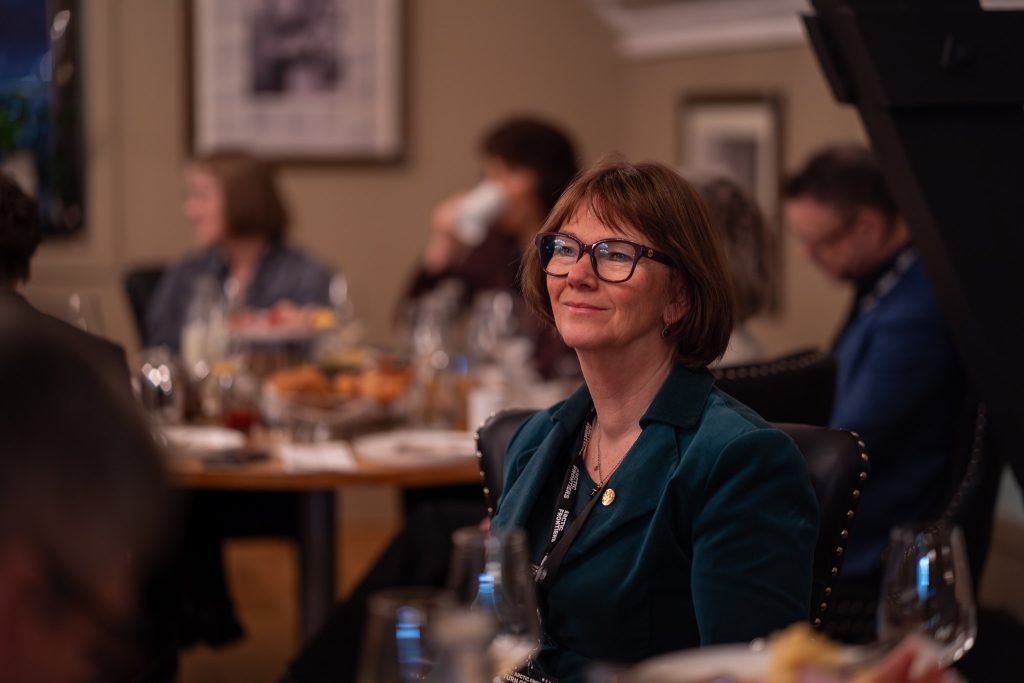
The Arctic Frontiers 2026 Conference in Tromsø marked a milestone this year, drawing more than 1,100 participants and over 120 international journalists—its highest attendance to date. Lise Øvreås, Academic Director of the Academia Europaea Bergen Hub, participated in in several panels at the conference.
Themed “Turn of the Tide,” the event captured global attention as leaders, researchers, and policymakers converged to discuss a rapidly changing Arctic, shaped by shifting geopolitical relations, increased defense considerations, and growing interest in the region’s strategic resources.
Recordings are available of both panels, organized by University of Bergen, where our Academic Director contributed:
Nature and Culture in the Anthropocene:
The panel addresses something fundamental in the way we think in the Anthropocene, formulated around the distinction between nature and culture. Is it possible to imagine knowledge that is no longer divided into social sciences, humanities and natural sciences?
Academia in Times of Geopolitical Change:
These are times of geopolitical change and uncertainty, including for the Arctic. How do academia and research institutions change, or not, with this? This side event addresses this challenge from several perspectives. On the one side there is the academic freedom and institutional autonomy which, when maintained, offer education and science-based knowledge beyond the urgency of the present. On the other hand, either by context, funding, or societal mandate, academia is constantly in flux, and thus also impacted by current geopolitical change.
In between there is the transition from academia and research institutes’ science-based advice to decision makers, rooted in the institutions’ independent research, to decision makers’ setting the research priorities and what to be advised on.
How do academic leaders manoeuvre this complicated terrain?